Georgia, the country is a singularly unique place. The food is amazing, the scenery various, from snowy mountains through bare flatland to seaside, the people inviting, the traditional dance insanely complicated and almost ballett-likely graceful, the writing beautifully curvy, the wine famous, the music uplifting. Here are some of the highlights of my Easter Week trip in 2017, including small clips of the Holy Saturday service beginning at 11 or 12 pm, with packed churches, full of choirs singing, "Halleluia" exclamations, and not ending till at least 3 or 4 am. The clips are from Batumi, Tbilisi, Kutaisi, the Azerbaijani border region, and many places in between.
A következő címkéjű bejegyzések mutatása: templom. Összes bejegyzés megjelenítése
A következő címkéjű bejegyzések mutatása: templom. Összes bejegyzés megjelenítése
2018. június 26., kedd


2013. július 13., szombat
Pavia


Pavia egy helyes olasz kisváros Milánó közelében, ahol újra találkozhattam Kathy barátnőmmel, Helsinkiből. :)
Nagyon tetszett amúgy a városka, középkori és kora újkori épületeivel, templomaival, és a meglepő felfedezéssel, hogy Szent Ágoston itt van eltemetve, egy véletéenszerűen meglátogatott, különösebben nem impresszív és grandiózus templomban. Hát, ezt is megértem.
2013. július 9., kedd
Rimini templomai- Tempio Malatestiano


Rimini híres templomai... A Tempio Malatestiano például, a befejezetlen Rimini katedrális,
Sigmondo Malatesta képével.
Sigmondo Malatesta képével.
2012. október 27., szombat
Comprehensive guide to Hungarian housing


Big old town houses
The prettiest ones, if you ask me. Budapest is filled with big, a hundred or so old houses. Many used to belong to one rich family or company, but was later divided into flats so that other people could move in. Socialism for you. They are typicly 4-6 floors high, and have a huge inner hight inside, like 4-5 meters between the floor and ceiling. Many have an inner courtyard, from where the doors are accessible. They look pretty :) Also, see my previous posts about 100 year old houses here and here.
Houses
with garden, detached houses, semi-detached houses
Typical, countryside houses, also outer districts of towns have them. Usually a single story, simply built, red roof. has a fence, sometimes a little bench just outside the fence, so that people can sit outside and live their social life. There are of course many forms...

Village church. This one happens to be Greek catholic. Barocchish...


And that is how a village looks like from the air.

Blocks of flats
The most popular living arrangement in towns. Or just the cheapest. And the smallest. And can possibly be the highest, if you live on the top floors. In the 1960s-1980s (I think) many blocks were built in quick succession to accomoidate the growing number of workers in big towns. They had uniform flats filled with the same stile wardrobes, same lamps, same beds. Very boring, if you ask me. Built from concrete and iron, grey-brown and black, waiting for families. Many are in a rather poor condition, lacking good materials and careful planning for the future. They usually exist in groups, like a flat block, and have 4, 5, or 10 floors. So, at least, the view can be good...


Well, that's it basicly. I have not talked about the traditional Hungarian countryhouse with straw roof and clay floor, with the traditional room arrangaments ("the clean room", kitchen, shed for the tools), maybe next time.
2011. április 11., hétfő
Budapest még több 100 éves háza
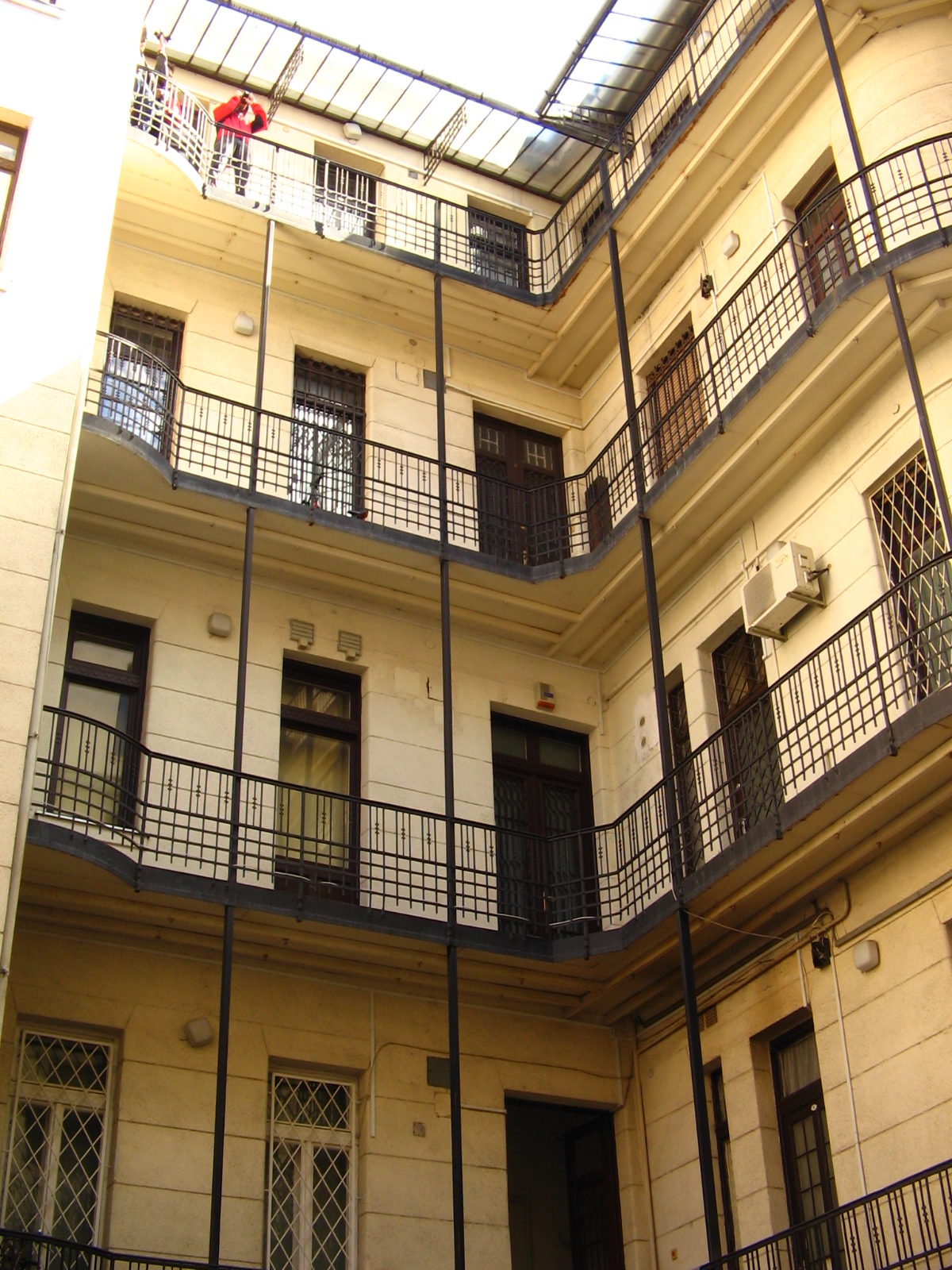 Hát, mi tagadás, nem álltam meg vasárnap sem, hogy el ne menjek megnézni néhány házat... Jártan a Váciúton, a Bécsi úton és a Rádayban.

Innentől kezdve jön a Ráday. Először gipszdíszek és az utókor hiányzó megbecsülése, aztán egy barátnőm akivel útközben találkoztam.


Az egyik házban a Nemzeti színházból kölcsönzött korhű ruhákban várták a betérőket büfécskével, asztalokkal, némafilmmel és zenével. Hence a zongora a folyosón. Egy néni nyomta fejből a némafilmzenét hatalmas nem törődömséggel és óriási hitelességgel :)


Íme a Ráday u.-i kollégium egykor és ma. Hogy miről híres? Titok. :)


Kilátás a Ráday 45-ből, 5.emelet.


2011. április 9., szombat
Budapest 100 éves házai
Nos ha már így feléledt ez a blog, elmesélem mit csináltam ma a Budapest 100 nevű rendezvény keretén belül.
Most hétvégén lehet megnézni vagy ötvenet Budapest 100 éves, azaz 1911-ben épült házai közül. Sok helyen programmal, vezetéssel, kisfilmmel, zsíros kenyérrel várják az érdeklődőket, és házmesterek, régi lakók mesélnek az épületek történetéről. Jómagam a Pozsonyi út- Újpest rakpart és a Balaton u- Falk Miksa u házaiban jártam, onnan a most következő vizuális beszámoló:


 Ezen a képen egy régi nappali/könyvtárterem/dohányzószoba látható, mostanság feldarabolva szobákra. Ezt a helységet a kecskeméti baromfitermelő cég használta laborként, tojásvizsgálat meg egyéb... most poros és üres.


 Ez itt az egyik padlástéren található öreg melegíthatő ruhaszárító. Szörnyen poros és hallatlanul izgalmas a padlástér!!!

 A következő képek a Pozsonyi út 14 alatti Szent Ágoston kápolnából valók. Igen, a TV is. Ez egy pincehelység, régen gumigyár raktár volt , azelőtt meg pékség... Úgy 60 éve premontrei kápolna.

 Tetőtér megint :) tejesbácsi.... :):):)


Most hétvégén lehet megnézni vagy ötvenet Budapest 100 éves, azaz 1911-ben épült házai közül. Sok helyen programmal, vezetéssel, kisfilmmel, zsíros kenyérrel várják az érdeklődőket, és házmesterek, régi lakók mesélnek az épületek történetéről. Jómagam a Pozsonyi út- Újpest rakpart és a Balaton u- Falk Miksa u házaiban jártam, onnan a most következő vizuális beszámoló:


 Ezen a képen egy régi nappali/könyvtárterem/dohányzószoba látható, mostanság feldarabolva szobákra. Ezt a helységet a kecskeméti baromfitermelő cég használta laborként, tojásvizsgálat meg egyéb... most poros és üres.

 Ez itt az egyik padlástéren található öreg melegíthatő ruhaszárító. Szörnyen poros és hallatlanul izgalmas a padlástér!!!
 A következő képek a Pozsonyi út 14 alatti Szent Ágoston kápolnából valók. Igen, a TV is. Ez egy pincehelység, régen gumigyár raktár volt , azelőtt meg pékség... Úgy 60 éve premontrei kápolna.
 Tetőtér megint :) tejesbácsi.... :):):)


2010. május 28., péntek
27 March, Thursday

Well, When I woke up I thought I`ll go to Bellinzona, but for some reason I ended up in Luzern with a trainpass thing... That 3 hours by train. On the way I had a pleasant conversation with a woman, who just had her yearly vacasion in Ascona, and have been in Budapest. Nice lady !
 One of Luzerns most famous construction is this wooden bridge. Built in the 14th c, burnt down and reconstructed. Inside there are pictures about Swiss historical events, stories.
 There is another, a bit less famous wooden bridge, its filled with Dance with the Death pictures...
 Two big churches, the Jesuitkirche, 1st Baroque church is town,
 and the Franciscan`s church. Here the organist practiced for next weekss mass, and sometimes got lost in his or her mind, improvising whatever came. And he or she played really well! A little Dvorzak, a little gragorian, whatever :):):):)
 The monastery (used to be at least...)
 And of course the famous Lion statue. It is the commemoration of Swiss soldiers defending a king and dying a heroic death!!
 On the train I tryed really hard to make pictures, the mountains were absolutely brilliant!!!
Feliratkozás:
Bejegyzések (Atom)